May 19, 2026 • James Barrett • 9 min reading time • Prices verified June 24, 2026
The Hammered-Finish Moment: Why Texture Is Reshaping the Italian-Inspired Table in 2025
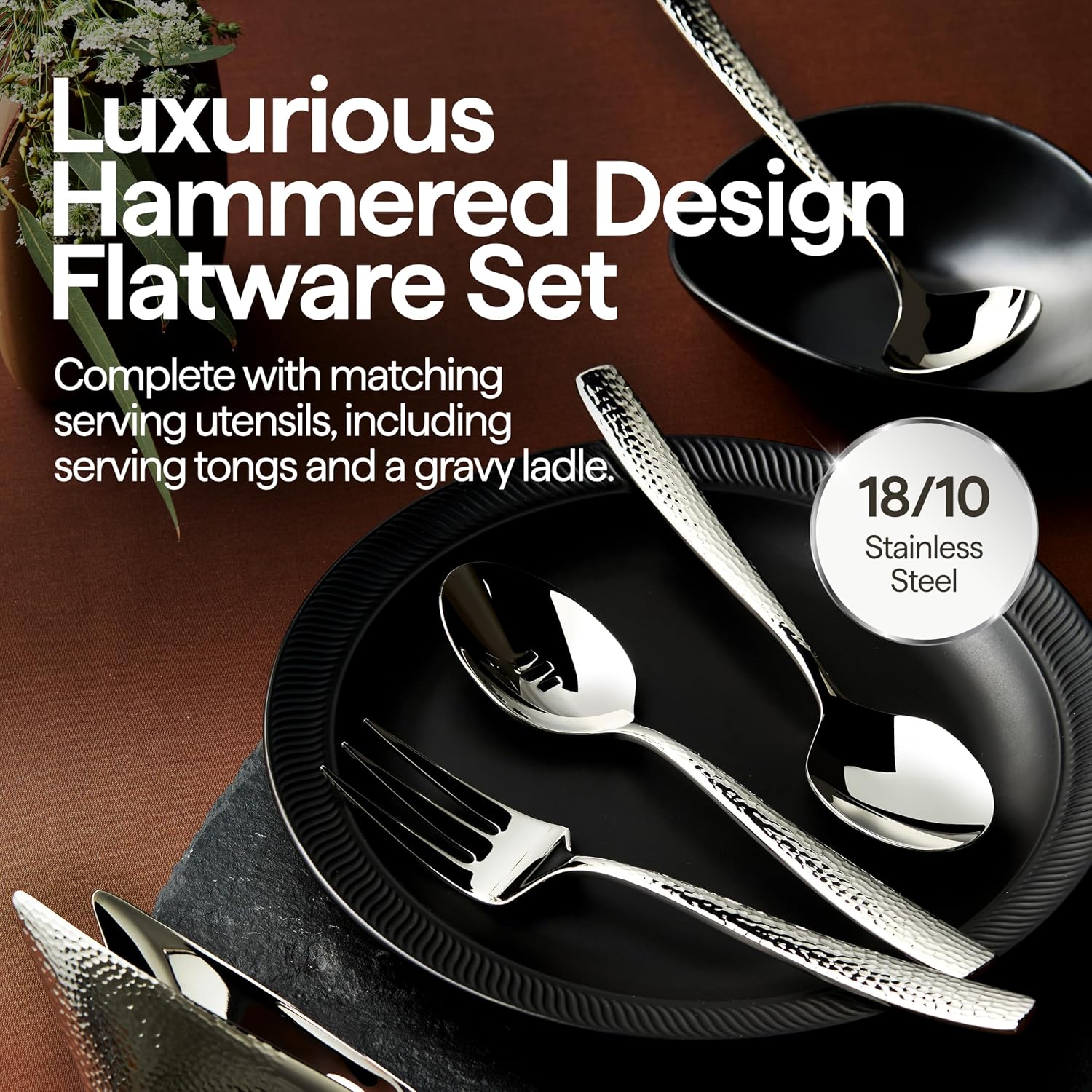
If you’ve ever picked up a fork and noticed that its surface looked like it had been gently tapped by a tiny hammer — a ripple of small dents that catch the light differently from every angle — you’ve encountered what the design world calls a hammered finish. The technique is ancient: silversmiths have been texturing metal by hand since at least the Renaissance, and the Italian ateliers of Florence and Valenza never fully abandoned it. What’s changed is that hammered flatware has moved from specialty-collector territory into the mainstream design conversation. Whether you’re building a registry, speccing a boutique-hotel table program, or hunting a discontinued Broggi pattern, understanding what separates a genuinely hand-worked surface from a machine-stamped approximation matters — both for what you pay and for what you get.
This guide is written for the reader who already knows the difference between 18/10 stainless and silver-plated brass, but who wants a clearer decision framework before committing. We’ll map the craft spectrum, name the tradeoffs, and give you the if-then rules you need to act.
| EDITOR'S PICKHammered Silverware Set with Se… | Mid-tier[DANIALLI Hammered Silverware Se…](https://www.amazon.com/dp/B07XPFBNX1?tag=greenflower20-20) | Budget pick[Hudson Essentials Hammered 18/1…](https://www.amazon.com/dp/B08HL7T658?tag=greenflower20-20) | |
|---|---|---|---|
| Piece Count | 45 | 60 | 8 |
| Includes Serving | ✓ | — | ✓ |
| Finish | Mirror | Hammered | — |
| Price | $219.99 | $195.49 | $59.95 |
| See on Amazon → | See on Amazon → | See on Amazon → |
Why Texture Is the Design Story Right Now
The shift away from mirror-polished flatware has been building for several years, but 2024–2025 saw it accelerate into something that looks less like a trend and more like a settled preference among design-forward buyers. Architectural Digest’s 2024 design trends report explicitly flagged “organic surface treatments” — including hammered, brushed-matte, and satin textures — as the primary direction in high-end tabletop, displacing the high-gloss silver aesthetic that dominated the 2010s. Elle Decor’s 2024 feature on Italian artisan craft made a complementary point: the hammered finish is functioning as a legibility marker for handwork in an era when mass production is ubiquitous and buyers want visible proof of human involvement.
There is a practical dimension, too. Food & Wine’s 2025 flatware survey noted that owners of hammered-finish pieces consistently report one key advantage: the textured surface is far more forgiving of everyday use. Minor scuffs and micro-scratches that make a polished piece look tired over time simply disappear into a hammered field — they read as part of the surface’s intentional character rather than as damage. For hospitality buyers running high-cover-count services, that resilience has real operational value.
The Italian silversmithing tradition is particularly well positioned to capitalize on this moment. The Piedmontese workshops around Valenza and the Florentine ateliers have always maintained hand-finishing as a living skill rather than a museum curiosity. As italianmade.com’s editorial profile of Sambonet documents, even industrial-scale Italian flatware producers preserve hand-finishing departments that other European manufacturers outsourced decades ago. That infrastructure means Italian makers can credibly meet demand for authentic hammered texture at a range of price points.
Reading the Craft Spectrum: Hand-Hammered vs. Machine-Stamped
This is the tradeoff that matters most, and it’s one that photographs poorly — you have to know what to look for in person or in high-resolution close-ups.
Genuine hand-hammered texture is produced by a craftsperson striking the metal repeatedly with a chasing hammer or planishing hammer, typically after the piece has been formed. Each strike is slightly different in angle and depth. The result is an irregular field of shallow depressions — no two identically spaced, the facets catching light at unpredictable angles. Under raking light, a genuinely hand-hammered surface has depth: some areas will be slightly more worked than others, and you can often see where the craftsperson transitioned between strokes. The 925-1000.com hallmark and surface-treatment reference guide notes that this variability is considered a quality indicator in the collector market, not a defect — it’s the visual signature of individual labor.
Machine-stamped texture uses a die press to imprint a repeating pattern into the metal’s surface during or after forming. The result is uniform: every depression is the same depth and the same distance from its neighbors. From arm’s length it reads as “hammered.” Under close inspection or raking light, the geometric regularity becomes apparent. Machine-stamped texture is not inherently inferior — it’s honest industrial production, and some Italian manufacturers are transparent about using it in their stainless lines while reserving hand-work for sterling and silver-plate. The problem arises when stamped pieces are marketed at hand-hammered prices without disclosure.
A practical test for the registry or hospitality buyer: Request a single sample piece from any shortlisted pattern. Photograph it under a single strong light source aimed at a shallow angle. If the shadow pattern repeats like a tile, it’s stamped. If it’s irregular and almost organic, the hand-work claim has merit.
The Italian Players: Where to Look and What to Expect
Mepra (Stainless, Professional Line)
Mepra’s Attesa and Dolce Vita patterns offer hammered texture in 18/10 stainless at a price point that hospitality buyers find defensible: current spec-sheet pricing puts a 24-piece place-setting service in the $280–$420 range depending on configuration. Owners and F&B procurement managers in aggregated reviews consistently flag Mepra’s balance weight as one of the better stainless executions — the hammered surface doesn’t compromise the ergonomics, which is a real risk when texture adds visual weight that the metal’s actual heft doesn’t match. For a twelve-cover boutique-hotel program, Mepra’s professional line is a sensible anchor: the texture reads well in candlelight, the 18/10 composition resists the harsh detergent cycles of commercial dishwashers, and replacement sourcing is reliable.
Sambonet (Stainless and Silver-Plate)
Sambonet’s Rugiada pattern — rugiada means “dew” in Italian, a name that tells you something about the surface intent — represents the brand’s most committed hammered-finish offering. In stainless, it sits in the $120–$200 per five-piece place-setting range; the silver-plated version climbs to $280–$380. As documented in italianmade.com’s Sambonet profile, the brand’s Vercelli workshops maintain hand-finishing as part of their production workflow even for volume pieces, which gives the Rugiada’s texture more irregularity than typical stamped competitors. Collectors tracking the brand’s history through Replacements Ltd’s pattern database will note that earlier Sambonet hammered patterns from the 1970s and 1980s — some released under Christofle collaboration agreements — command a meaningful premium in the secondary market, a data point worth holding if you’re evaluating the Rugiada’s long-term value trajectory.
Greggio (Sterling-Plate, Collector Tier)
Greggio’s sterling-plated offerings represent the upper end of the hammered-finish spectrum for a non-bespoke buyer. Their hand-finished pieces in the Martellato style (martellato simply means “hammered” in Italian) are individually worked, and the price reflects it: $400–$700 per five-piece place setting is consistent with current market positioning. At this tier, the collector consideration is explicit — these are pieces meant to age, to be passed down, and to appreciate alongside silver spot prices. The 925-1000.com reference guide’s treatment of silver-plate hallmarking is useful background for anyone evaluating Greggio pieces in the secondary market: look for the micron rating of the silver deposit (25 microns is the serious collector’s floor) and the substrate metal declaration.
The Buccellati and Broggi Secondary Market
For the collector hunting discontinued hammered-pattern pieces, Replacements Ltd’s Italian-pattern listings show active inventory in both Buccellati and Broggi hammered-surface patterns, with per-piece pricing that reflects both pattern completeness pressure and the broader uptick in demand for textured Italian silver. Pattern completeness is the key variable here: a twelve-cover service missing two salad forks is a different negotiation than a complete set with serving pieces. The practical rule is to set a completeness threshold before you start bidding — 90% complete and above for a primary table service, lower thresholds only if you have a realistic path to filling gaps through the same dealer or auction relationship.
By the Numbers
| Tier | Representative Pattern | Material | Per-5-Piece Place Setting | Hospitality 12-Cover Program (est.) |
|---|---|---|---|---|
| Entry-practitioner | Mepra Attesa | 18/10 stainless | $85–$140 | $1,020–$1,680 |
| Mid-collector | Sambonet Rugiada | Silver-plate | $280–$380 | $3,360–$4,560 |
| Serious collector | Greggio Martellato | Sterling-plate | $400–$700 | $4,800–$8,400 |
| Secondary market | Broggi vintage hammered | Sterling/silver-plate | $120–$600+ (per piece) | Varies by completeness |
Pricing based on published retail and current secondary-market aggregates as of May 2026. Silver spot movement affects silver-plate and sterling tiers directly; stainless pricing is effectively spot-insulated.
The Tradeoffs You Need to Name Before You Decide
Texture and cleaning friction. The same surface variability that gives hand-hammered pieces their beauty creates more surface area for food residue to catch. Owners of genuine hand-hammered sterling and silver-plate consistently report that polishing takes longer than with smooth pieces — the cloth has to work into the depressions. For a daily-use household table or a high-volume restaurant service, this is a real labor consideration. Machine-stamped stainless texture is shallower and doesn’t present the same issue.
Texture and food visibility. In fine-dining plating contexts, several F&B directors have noted — and Food & Wine’s 2025 survey captures this — that heavily hammered surfaces can compete visually with delicate plate presentations. A smooth mirror bowl reads neutrally; a deeply textured bowl surface adds its own visual noise. The solution most hospitality buyers land on: hammered handles, smoother bowl and tine surfaces. Several Mepra professional configurations offer exactly this split.
Trend risk vs. craft value. This is the core tension for the intermediate buyer. Hammered finish is undeniably in a peak-visibility moment. If you’re speccing a hotel program that you’ll evaluate for refresh in five years, you’re exposed to the possibility that the aesthetic reads dated by then. The counter-argument — and it’s a strong one — is that genuinely hand-worked Italian silver has never really gone out of style; it’s the machine-stamped approximation that tends to date fastest. Buying at the Greggio or authentic hand-work tier is a more durable investment than buying a stamped stainless pattern whose appeal is entirely trend-dependent.
The Decision Rules
If you’re building a registry and your budget is under $200 per place setting: Mepra’s stainless hammered lines give you the aesthetic, the Italian provenance, and durability that holds up to real life. Don’t overthink it — start here, and let the collection grow over time.
If you’re a hospitality buyer speccing a signature flatware program: The split-surface approach (hammered handles, smoother functional surfaces) solves both the plating-visibility and cleaning-labor problems. Mepra’s professional configurations are the easiest path; Sambonet’s trade program is worth a conversation if you want a silver-plate tier that photographs distinctively.
If you’re a collector evaluating a Greggio or Broggi hammered-pattern acquisition: Authenticate the micron rating on silver-plate pieces before committing. For secondary-market buys, set your completeness threshold in advance and stick to it — pattern gaps in hammered Italian silver are genuinely hard to fill, and the cost of hunting individual pieces can quickly exceed the premium for buying complete.
If you’re watching the secondary market for Buccellati or discontinued Broggi patterns: The current hammered-finish moment is lifting secondary prices for Italian textured silver across the board. That means now is a better time to sell than to buy speculatively, but if you find a near-complete service at a price anchored to pre-trend market rates, the upside is real.
Texture has always been part of the Italian silversmithing vocabulary. What’s different in 2025 and 2026 is that the broader design culture has finally caught up. The craft was waiting — the question now is just whether you want to meet it at the stainless entry point or carry it all the way to sterling.