June 9, 2026 • James Barrett • 9 min reading time • Prices verified June 24, 2026
Building a 12-Cover Heirloom Registry: Place-Setting Costs, Pattern Longevity, and What to Buy First
You already know you want Italian flatware — something with weight to it, a pattern you can picture on the table forty years from now. What you’re working through is the how: how many pieces, in what order, at what total cost, and which brands will still be around (and still making replacement spoons) when that timeline arrives. This guide is for that stage. We’ll walk through what a true 12-cover heirloom service actually costs in 2026, how to sequence your purchases so you aren’t over-extended early, which Italian patterns and makers have the track record to justify heirloom framing, and where the real tradeoffs live — sterling versus silver-plate, open-stock availability versus limited-edition risk, and buying new versus hunting the secondary market. If you’re just starting to research flatware, every term is defined as it comes up. If you’re mid-registry, skip to the section that’s live for you right now.
What “12 Covers” Actually Costs: Building the Budget Before You Build the Registry
A “cover” in flatware language means one complete place setting — the pieces one person uses at a formal dinner. A standard five-piece place setting (dinner knife, dinner fork, salad fork, soup spoon, teaspoon) is the baseline; a formal eight-piece setting adds a fish fork, fish knife, and dessert spoon. Multiply by twelve, add serving pieces, and the numbers compound fast.
By the numbers — 2026 mid-range estimates for a 12-cover Italian flatware program:
| Tier | Per-Setting (5-piece) | 12-Cover Subtotal | Add Serving Set (+6 pcs) | Approx. Total |
|---|---|---|---|---|
| Sambonet / Mepra 18/10 stainless | $80–$150 | $960–$1,800 | $200–$400 | $1,160–$2,200 |
| Ricci Silverware silver-plate on brass | $280–$480 | $3,360–$5,760 | $600–$1,200 | $3,960–$6,960 |
| Greggio sterling-plate / vermeil | $420–$650 | $5,040–$7,800 | $900–$1,800 | $5,940–$9,600 |
| Florentine bespoke / Buccellati-tier sterling | $600–$1,200+ | $7,200–$14,400 | $1,500–$3,000+ | $8,700–$17,400+ |
These figures reflect open-market pricing as of May 2026; silver spot price (LBMA fix hovering near $32–$34/troy oz at time of writing) has meaningfully widened the gap between silver-plate and sterling in the past eighteen months. Elle Decor’s luxury registry features have flagged this spread as the central calculus for 2025–2026 registry planning — sterling flatware carries more intrinsic metal value but silver-plate on quality brass (the Ricci and Greggio model) offers near-identical aesthetic longevity at roughly 60–70 cents on the sterling dollar.
The decision frame here is straightforward: if your primary goal is tangible asset value that tracks silver markets, weight your spend toward sterling or high-silver-content plate; if your goal is daily-use heirloom beauty with lower financial exposure, quality silver-plate on brass is the more defensible choice for most registries.
Pattern Longevity: The Single Highest-Leverage Variable
Most registry mistakes aren’t about overspending — they’re about pattern selection. A pattern that gets discontinued five years after your wedding leaves you unable to replace a lost salad fork without haunting Replacements Ltd (which, for the record, is an excellent resource, but no substitute for open-stock availability).
Architectural Digest’s tableware coverage consistently emphasizes that pattern longevity correlates with three observable signals:
1. How long has the pattern been in continuous production? Sambonet’s Imagine and Gio Ponti lines have been in production for decades; Mepra’s Dolce Vita entered the catalog in the early 2000s and remains a professional-line staple. Patterns with 20+ year production histories are statistically more likely to remain open-stock. Conversely, limited-edition or collaboration releases — however beautiful — are a calculated risk for a 12-cover service you plan to add to for thirty years.
2. Does the maker have a documented open-stock policy? “Open-stock” means individual pieces are sold separately, not only as sets. This matters the moment you break a piece or want to add place settings. Ricci Silverware and Greggio both publish open-stock availability for their core collections; confirm this before committing. Per the italianmade.com manufacturer profiles, several Florentine ateliers operate on order-minimum models that effectively preclude casual replacement purchasing — important to verify at contract stage.
3. Is the pattern documented in secondary-market archives? The Replacements Ltd pattern archive is the most reliable proxy for this. If a pattern is indexed there with active inventory, it has enough collector demand to sustain a secondary market — meaning even in a worst-case discontinuation scenario, you have a path to replacements. If it isn’t indexed, you’re building without a safety net.
The tradeoff to name explicitly: The most pattern-stable choices (long-production Sambonet and Mepra stainless, core Ricci silver-plate lines) are also the least exclusive. If rarity and distinctiveness matter to your registry, you’re accepting some longevity risk. The honest answer is that a registry is a 30-year commitment, and exclusivity optimizes for the first decade; open-stock availability optimizes for every decade after.
What to Buy First: Sequencing a Registry That Doesn’t Strand You
The most common sequencing mistake is buying serving pieces before you’ve locked your place-setting pattern. Serving pieces — salad servers, carving sets, fish slices — are often the first to be discontinued when a maker rationalizes a line. Acquire your 12 five-piece place settings first, confirm the pattern is still open-stock, then layer in serving pieces and specialty items.
A practical acquisition sequence for a 12-cover heirloom registry:
Phase 1 — Core 12 (months 1–6 of registry window) Twelve five-piece place settings. This is your structural commitment. Use the registry period (typically 12–18 months for engaged couples) to fund this phase via gift purchases. Don’t let well-meaning relatives buy serving pieces until Phase 1 is complete — a beautiful fish slice in a pattern you can’t complete to 12 covers helps no one.
Phase 2 — Serving Foundation (months 6–12) Two to three serving spoons, one large serving fork, and a cold-meat fork cover 80% of entertaining scenarios. At the Ricci silver-plate tier, budget $600–$900 for this package. At Mepra stainless, you’re looking at $180–$350.
Phase 3 — Specialty and Depth (post-registry) Dessert spoons, butter knives, fish flatware, and additional place settings (moving from 12 to 16 covers) come here. This phase often extends for years and is where secondary-market sourcing becomes genuinely useful — particularly for discontinued pieces from patterns you’ve already committed to.
Phase 4 — Heirloom Anchors (opportunistic) One or two investment-grade sterling or vermeil pieces — a significant serving ladle, a fruit set, a matched pair of carving implements — that anchor the collection aesthetically and financially. These are the pieces that photograph well, get passed down deliberately, and justify the “heirloom” framing. At this stage, Replacements Ltd, specialist dealers, and Florentine auction houses become your sourcing channels alongside retail.
The 18/10 vs. Silver-Plate vs. Sterling Decision Matrix
The alloy and plating question is where most intermediate-level buyers spend the most time and often the most anxiety. Here’s the honest matrix:
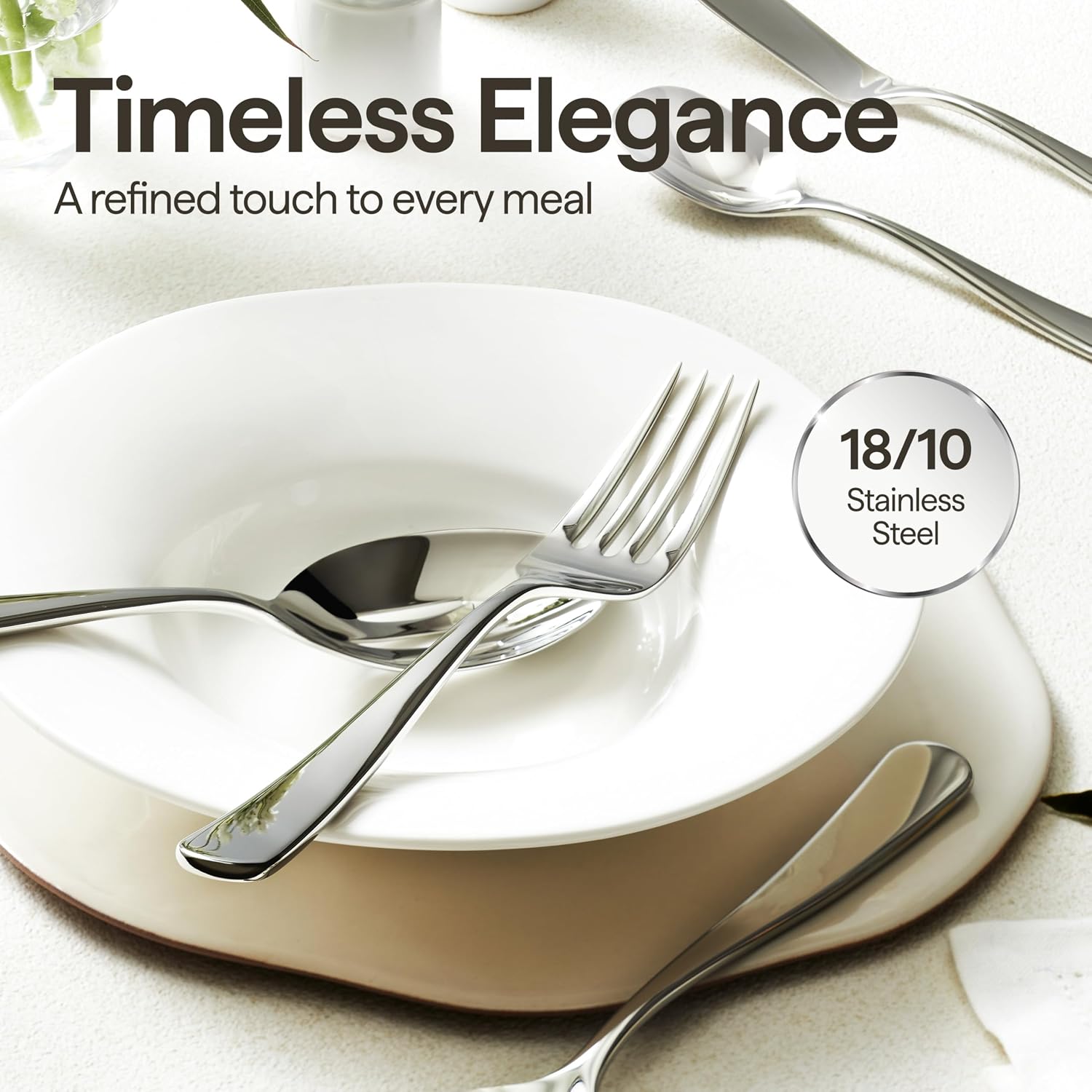
18/10 stainless steel (the grade used by Sambonet and Mepra’s professional lines) contains 18% chromium and 10% nickel. Per the 925-1000.com alloy reference, this grade is the most corrosion-resistant common flatware alloy, dishwasher-safe without qualification, and effectively permanent under normal use. Owners and hospitality operators consistently report zero degradation over 10–15 year service cycles. The tradeoff: no intrinsic precious-metal value, and the aesthetic warmth of silver is absent. For the hospitality buyer sourcing a 12-cover signature program, 18/10 from Mepra’s professional line is the rational choice — performance is documented, replacement procurement is straightforward, and total-cost-of-ownership math favors it clearly.
Silver-plate on brass (Ricci, Greggio core lines) layers a measurable silver coating — typically 40–80 microns in quality Italian production — over a brass substrate. The 925-1000.com guide to Italian plating standards notes that pieces marked “argento” or carrying the Italian silversmith’s hallmark should be verified against the national registry for actual silver content and plating depth. Owners of quality silver-plate report that with appropriate care (hand-washing, proper storage in anti-tarnish cloth), the surface holds for decades. The tradeoff: it is not dishwasher-safe without risk, it will tarnish and require polishing, and the silver layer is not permanent in the way sterling is. But the visual and tactile experience is genuinely closer to sterling than stainless, and for a registry framed as heirloom, that difference matters.
Sterling silver (925/1000 silver content, the standard tracked by LBMA) is the generational benchmark — pieces from Italian ateliers working in sterling are the ones that appear in estate sales and auction houses a century later. The cost premium over silver-plate is real (see the table above), and at current silver spot prices that premium has widened. For the buyer who is also a collector — someone who thinks about intrinsic metal value, who might one day liquidate or donate a piece to a museum collection — sterling is the correct answer regardless of price. For everyone else, the honest case for sterling over high-quality silver-plate is thinner than the marketing suggests.
If X, then Y — the decision rule:
- If you’re building a registry with a 30-year use horizon and dishwasher access is non-negotiable: 18/10 stainless from Sambonet or Mepra
- If you want silver aesthetics, hand-washing isn’t a burden, and budget is $3,000–$7,000 total: silver-plate on brass from Ricci or Greggio core lines
- If intrinsic metal value, long-term collectibility, and estate-quality provenance matter more than cost: sterling from a Florentine atelier, verified against the national hallmark registry via 925-1000.com
- If you’re the hospitality buyer sourcing a 12-cover program with repeat procurement: Mepra professional-line 18/10, open-stock confirmed, with a per-unit replacement cost locked in your supplier agreement
A Note on Timing: Silver Spot Price and Registry Strategy
With LBMA silver fixing in the $32–$34/troy oz range through early 2026 — up significantly from the $18–$20 range of 2020–2021 — sterling and high-silver-content plate are carrying meaningful cost premiums relative to five years ago. Elle Decor’s registry trend reporting has noted a corresponding shift toward silver-plate over sterling among design-forward couples who are price-sensitive to the current spread.
The collector calculus runs the other direction: if you believe silver spot has further to run (a view held by a number of commodity analysts, though not a certainty), sterling flatware purchased now at $32–$34 silver represents a better relative value than it did at $45 spot. Pattern completeness and provenance still drive secondary-market pricing more than metal value for collectible Italian pieces per the Replacements Ltd pricing database — but metal value sets a floor that silver-plate and stainless simply don’t have.
For registry buyers, the practical implication is this: if sterling is the goal, the argument for moving on it now rather than waiting for a silver pullback is reasonable. If silver-plate is the choice, spot price is largely irrelevant to your decision — you’re buying a finished aesthetic object, not a commodity position.
The 12-cover heirloom registry is one of the few purchases most people make that is genuinely designed to outlast them. The patterns you select, the maker you trust, and the sequence in which you build will shape a table environment for decades. Get Phase 1 right — twelve place settings in a pattern with documented longevity and confirmed open-stock availability — and everything else is refinement. The perfect set is the one that’s still complete in forty years, and still makes someone feel like the table was set just for them.