April 30, 2026 • James Barrett • 9 min reading time • Prices verified June 24, 2026
The Hostess Set, Elevated: Serving Utensils That Finish an Italian-Inspired Table Without Compromise
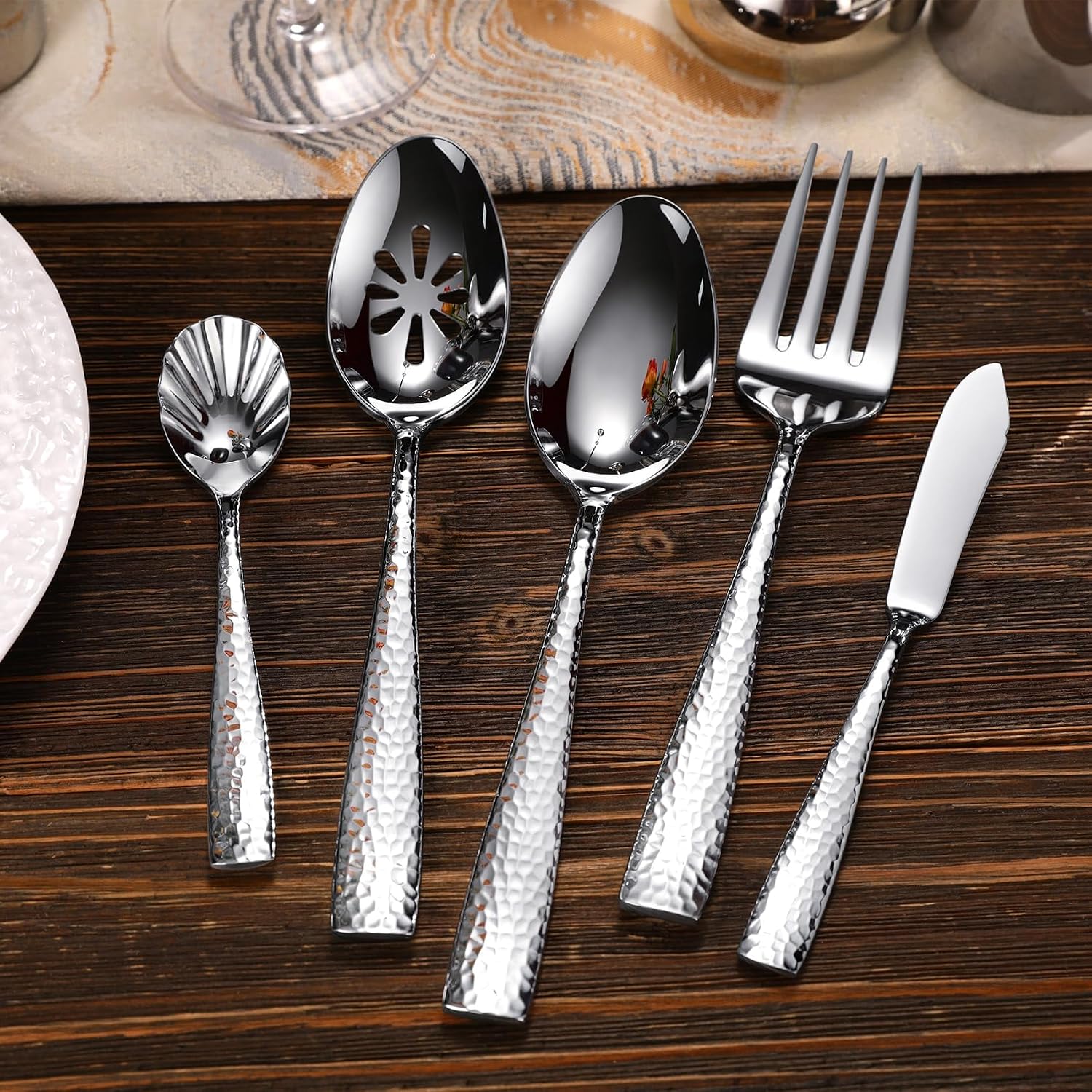
You’ve spent real time — and real money — choosing a flatware pattern that feels right. The weight of the fork, the proportion of the knife handle, the way a particular finish catches candlelight. And then, at the moment of serving, out come the mismatched tongs from the back of a drawer and the ladle that belongs to a different decade entirely. Every experienced host knows this small defeat. Serving utensils — the pieces used to transfer food from platter to plate in front of guests — are the final chapter of a table story, and they’re the chapter most often left unfinished.
This guide is for the reader who already has a pattern in mind (or in hand) and is now thinking seriously about completing it. We’ll look at what distinguishes a well-made Italian hostess or serving set from a generic alternative, how to navigate the decision between matching-pattern serving pieces and intentional mixed-metal approaches, what the realistic price ranges look like in mid-2026, and how to make the call when your budget and your ambitions are in productive tension.
| EDITOR'S PICK[Oneida Dover 6-Piece Serving Set](https://www.amazon.com/dp/B004OC1UQS?tag=greenflower20-20) | Mid-tier[Godinger Silver Art Dora Vita L…](https://www.amazon.com/dp/B01DNDLD38?tag=greenflower20-20) | Budget pick[KEAWELL Premium Louis Hammered…](https://www.amazon.com/dp/B0CJ6W21BC?tag=greenflower20-20) | |
|---|---|---|---|
| Material | — | 18/0 Stainless Steel | 18/10 Stainless Steel |
| Finish | — | Light Gold-plated | Mirror Finish |
| Pieces | 6 | 3 | — |
| Dishwasher Safe | — | — | ✓ |
| Design | — | — | Hammered, Squared Edge |
| Price | $74.95 | $43.99 | $22.99 |
| See on Amazon → | See on Amazon → | See on Amazon → |
What a “Hostess Set” Actually Includes — and Why It Matters
The term hostess set has a specific meaning in the flatware world: it typically refers to a curated grouping of serving utensils sold together — most commonly a serving spoon, a cold meat or buffet fork, and sometimes a pie or cake server. Some Italian manufacturers expand this to five or six pieces, adding a salad set (a large fork and spoon), a sauce ladle, and a butter server. The set logic matters because it solves a coordination problem: the pieces are designed to share the same handle geometry, finish, and decorative motif, so they read as a unified family on the table even if they come from a different production run than your place settings.
This is not a trivial design challenge. A serving spoon in 18/10 stainless steel (the grade most often used in Italian professional and consumer flatware — the numbers refer to the chromium and nickel content that give the steel its corrosion resistance and mirror polish) must be scaled up from a dinner spoon proportionally, or it looks clumsy. The bowl depth, the neck taper, the handle length — every dimension is a design decision, and the best Italian makers treat serving pieces with the same rigor they apply to a five-piece place setting. Mepra’s Natura line and Sambonet’s Contour collection, both documented in italianmade.com’s flatware producer directory, are frequently cited as examples where serving and place-setting pieces share a coherent design language at scale.
The Three Decision Axes: Match, Mix, or Commission
Axis 1 — Matching Pattern Serving Pieces
If your pattern is current production from Mepra, Sambonet, or Greggio, matching hostess sets are generally available and priced as a logical extension of the per-place-setting cost. The Spruce Eats’ flatware buying guide notes that most mid-to-high-tier manufacturers produce at minimum a five-piece hostess set alongside their main pattern lines — but the catch is inventory timing. Serving pieces often run in smaller production batches, and a pattern that is fully in stock for place settings may have a six-to-twelve-week lead time on the hostess set. If you’re building a registry or furnishing for a specific event date, order serving pieces first, not last.
The math here is straightforward:
By the numbers — Matching serving set cost benchmarks (May 2026)
- Entry stainless (Sambonet, Mepra stainless lines): €65–€130 for a 3-piece set
- Mid-tier silver-plated (Greggio, Broggi): €180–€380 for a 5-piece set
- Sterling-plated / luxury (Ricci, Christofle Italy collaborations): €450–€900+ for a 6-piece set
Axis 2 — Intentional Mixing: The Florentine Approach
The Florentine silversmithing tradition, documented in detail by 925-1000.com’s Italian hallmarks reference, has historically treated the table as a collected environment rather than a matched set. Antique dealers along Via dei Fossi in Florence regularly assemble serving collections from multiple ateliers — an early-20th-century ladle in silver plate alongside a postwar buffet fork in sterling, unified by a shared visual register (oxidized detailing, grape-and-vine motifs, or architectural borders) rather than identical manufacture.
This approach requires more editorial judgment but opens the collector market. Replacements Ltd’s pattern search and serving pieces category maintains active inventory in discontinued Italian and Italian-collaboration patterns — Buccellati’s Primrose and Grapes are periodically available in serving pieces even when place settings are complete — and the provenance of a found piece often exceeds the design coherence of a new-production match. Architectural Digest’s guide to building a collected table specifically calls out the serving layer as the most forgiving place to introduce contrast, because these pieces are read as a group in motion rather than side by side in repose.
The tradeoff: curation takes time and expertise. If you’re sourcing through Replacements Ltd or specialist dealers, budget for a 60–90 day search window and expect to pay a 15–30% premium over new-production equivalents for authenticated vintage pieces in good silver condition.
Axis 3 — Bespoke Commission
For the hospitality buyer specifying a signature program, or the collector building a multi-generational service, commissioning serving pieces from a Florentine or Valenzano silversmith remains viable in 2026 — but the economics have shifted. Silver spot prices (LBMA fix as of May 2026) remain elevated relative to 2022–2023 averages, which means the material cost component of a sterling commission is running approximately 18–22% higher than it would have three years ago. italianmade.com’s producer directory lists several Valenza-based ateliers that accept bespoke commissions for serving pieces with a minimum order of six matched pieces; lead times run 16–24 weeks and pricing is negotiated against silver weight plus a design/labor multiple.
For a hospitality buyer, the business case for bespoke hinges on brand differentiation and repeat procurement: a signature twelve-cover service specification including serving pieces can exceed €4,500–€5,500 at current material and labor rates, but the per-unit cost normalizes favorably against a five-year procurement horizon if the pattern is held exclusively.
Material and Finish: Where Italian Serving Pieces Diverge from the Generic Market
The finish question matters more for serving pieces than for place settings, because serving utensils experience higher contact variation — acidic foods, heat from stove to table, the friction of a serving counter. Food & Wine’s coverage of formal table-setting essentials consistently emphasizes that the serving layer is where budget-grade finishes reveal themselves fastest: the lacquer on a cheap silver-plate piece chips at the bowl edge within two years of regular use, while a properly struck (electroplated to specification) silver layer on a quality Italian piece is designed for 40-year service.
What to look for in the spec:
- 18/10 stainless as a base for unplated pieces — the chromium/nickel ratio that prevents rust and maintains polish. Italian professional lines from Mepra routinely publish this specification; any serving piece that omits the grade designation in its product documentation is almost certainly 13/0 (no nickel, prone to rust at the joint).
- Silver plate thickness in microns for plated pieces — Greggio and Broggi typically plate to 40–60 microns on serving pieces; budget alternatives often run 15–20 microns, which owners consistently report thinning to bare base metal within five years on high-use pieces like serving spoons.
- Handle construction — a one-piece (monoblock) construction in serving utensils is preferable to a hollow-handle design for pieces that will be washed regularly. Water ingress into hollow handles is the single most cited failure point in long-run owner reviews of mid-tier serving pieces, per aggregated feedback tracked across specialty retailers.
If-Then Decision Rules for Your Current Situation
This is the practical synthesis — where the variables above resolve into a call.
If you have a current-production Italian pattern and your event is within 90 days: Order the matching hostess set now, directly from the manufacturer’s authorized retailer. Don’t wait. Inventory on serving pieces moves unpredictably, and a backordered ladle the week of a wedding reception or restaurant opening is a problem that money can’t easily solve on a short timeline.
If your pattern is discontinued or you’re building a collected vintage table: Start your Replacements Ltd search in parallel with checking specialist dealers. Set a ceiling for the silver condition you’ll accept — anything below “very good” (light surface wear, no plate loss at high-contact points) on a serving piece will show immediately in use. The Florentine mixed approach is your friend here; don’t hold out for a perfect match if a complementary period piece in excellent condition is available.
If you’re a hospitality buyer building a signature program: The bespoke commission path makes financial sense only if you’re committing to exclusivity and a multi-year procurement relationship. If the program is speculative or likely to evolve, current-production Mepra professional lines offer the best balance of design coherence, durability specification, and reliable reorder availability. A twelve-cover set with full serving complement in the Mepra Synthesis or Ginevra professional lines is spec-publishable, repeat-orderable, and documented — which matters for F&B operations where staff turnover and procurement continuity are real variables.
If you’re working with an entry-to-mid budget (€80–€200 for the serving layer): Sambonet’s stainless collections represent the most credible Italian-made entry at this price point, and their hostess sets are sold in a way that allows incremental addition — you can start with the serving spoon and cold meat fork, then add the salad set in a second purchase. This is a better long-term strategy than spending the same money on a full set from a non-Italian, non-specification-documented brand.
A Note on Timing Your Purchase Against Silver Markets
For anyone buying silver-plated or sterling-plated serving pieces, silver spot price is a real variable. The LBMA daily fix as of May 2026 has silver trading in a range that makes new sterling-plated serving pieces approximately 12–18% more expensive than their 2021 equivalents in euro terms. That premium is largely absorbed in the manufacturer’s material cost and passed through at retail. The practical implication: if you’re on the fence between buying now and waiting for a price correction, the collector’s calculus generally favors the known piece over the speculative discount — Italian serving pieces in desirable patterns don’t sit in inventory waiting for silver to dip, and the opportunity cost of an incomplete table is real.
The one exception: bespoke commissions where the atelier quotes you a silver-weight-plus-labor structure. In that case, monitoring the LBMA fix and timing your deposit around a dip genuinely moves the final price. It’s worth asking any Valenza or Florence atelier whether they’ll lock a silver price at deposit or calculate at delivery.
The serving layer is where a table stops being assembled and starts being composed. Italian silversmithing tradition has always understood this — the hostess set was never an afterthought in the ateliers of Valenza or the workshops along the Arno. It was the punctuation mark on everything that came before it. Get those pieces right, and the table tells a complete story.