May 8, 2026 • James Barrett • 9 min reading time • Prices verified June 24, 2026
Lenox Portola, Alcott, and Studio 1414: Which Pattern Deserves a Place on Your Registry?
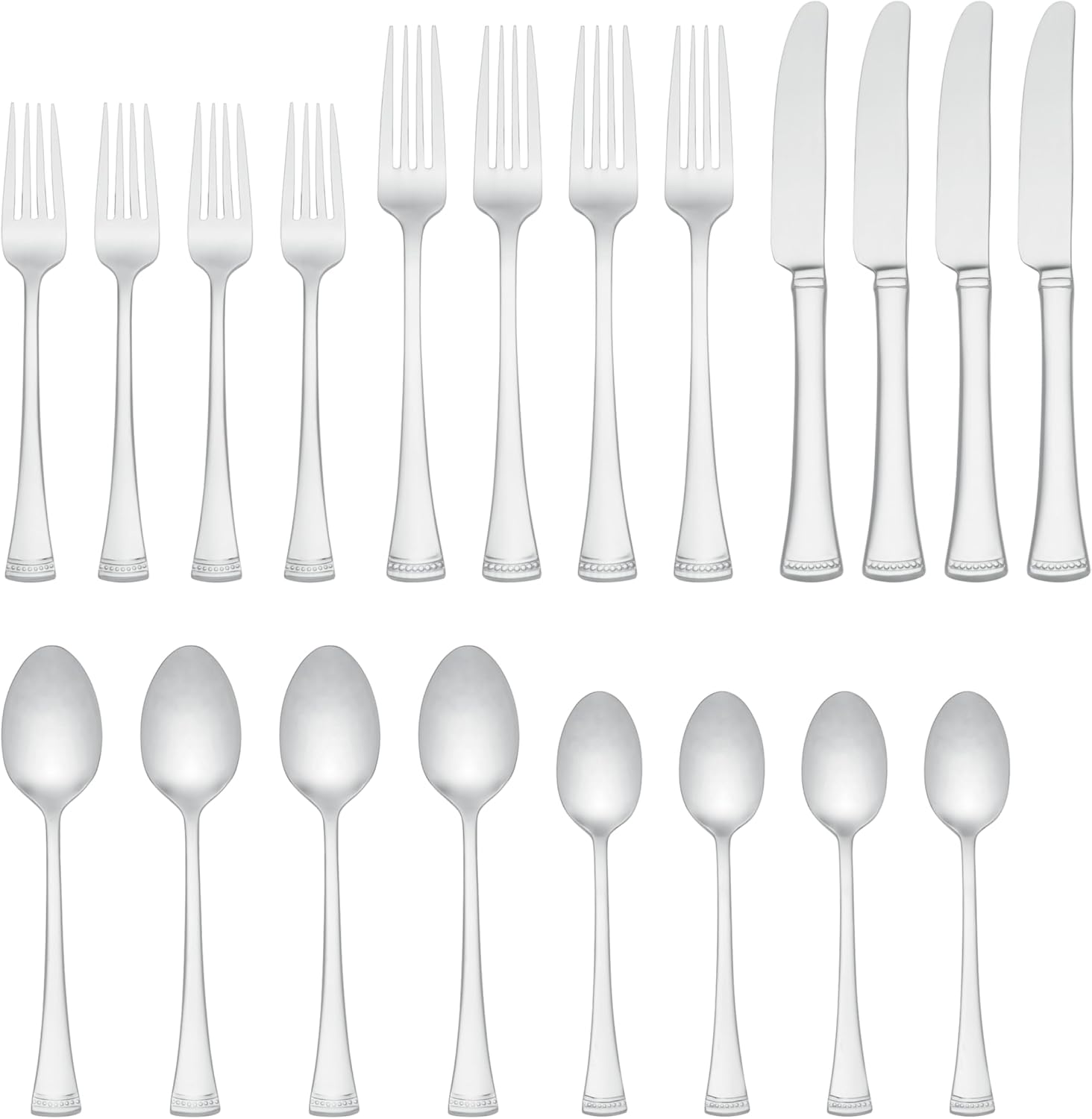
If you’ve ever stood in a department store with a registry gun in your hand, or scrolled through page after page of flatware listings at two in the morning, you already know the feeling: every set looks roughly the same until you start asking the right questions. Flatware — that’s the knives, forks, and spoons your guests will actually hold at your table — is one of those purchases that seems minor until you realize you’ll be washing it, setting it, and looking at it for the next thirty years. Lenox is an American brand with genuine heritage (founded in New Jersey in 1889, best known for its fine china), and its flatware lines have expanded considerably over the past decade into 18/10 stainless — meaning the steel contains 18% chromium for hardness and 10% nickel for the bright, corrosion-resistant finish that serious tableware buyers look for. Three of its current patterns get the most registry attention right now: Portola, Alcott, and Studio 1414. This guide breaks down the real differences between them, names the tradeoffs, and ends with a clear decision rule so you can move forward.
| EDITOR'S PICK[Lenox Silverware Set For 12](https://www.amazon.com/dp/B003FKCA6E?tag=greenflower20-20) | Mid-tier[Lenox Silverware Set](https://www.amazon.com/dp/B0FXCD5VQV?tag=greenflower20-20) | Budget pick[Lenox Silverware Serving Utensi…](https://www.amazon.com/dp/B0C53V8P7K?tag=greenflower20-20) | |
|---|---|---|---|
| Pieces | 65 | 36 | 5 |
| Service For | 12 | 12 | — |
| Finish | — | Mirror | Mirror |
| Includes Hostess Set | ✗ | ✗ | ✓ |
| Price | $131.60 | $63.81 | $32.68 |
| See on Amazon → | See on Amazon → | See on Amazon → |
What You’re Actually Comparing: Gauge, Geometry, and Finish
Before the patterns themselves, a word about the spec that matters most and almost never appears in the marketing copy: gauge, or how thick the steel blank is before it’s shaped. Heavier gauge translates to a more substantial feel in the hand — less flex, more presence on the table, and generally a longer service life under daily use. The industry standard for quality consumer flatware is 2.0–2.5mm at the handle; budget sets often run 1.5mm or below, which reviewers at The Spruce Eats consistently flag as the first thing that separates a set that feels like a real investment from one that feels like it came with the apartment.
Lenox doesn’t publish gauge numbers as prominently as, say, a professional-line manufacturer like Mepra does in its spec sheets for the hospitality segment. That’s worth noting. What they do publish — and what matters for registry buyers — is the steel grade (18/10 across all three of these patterns), the finish type (mirror-polish versus brushed/satin), and the handle profile. Those three variables are where Portola, Alcott, and Studio 1414 actually diverge.
Portola runs a slim, tapered handle with a high-gloss mirror polish and a gently faceted spine — the kind of clean, slightly Art Deco geometry that photographs well and suits formal or transitional dining rooms. The silhouette is narrower at the neck than the bowl or blade, giving it a pinched elegance that reviewers across aggregated listings tend to describe as “hotel silverware done right.”
Alcott is the warmest of the three in hand-feel, based on published profiles. It uses a broader, flatter handle — closer to the English “Old English” tradition — with a satin finish that diffuses light rather than reflecting it. Owners consistently report that the satin surface hides minor water-spotting better than the mirror alternatives, which is a practical daily-use advantage that doesn’t show up in the product photography.
Studio 1414 is Lenox’s most contemporary play. The handle geometry is architectural — squared-off edges, a matte/brushed finish, and proportions that favor a longer, leaner aesthetic. It reads as genuinely modern in the way that a Mepra Attiva or a Sambonet Bamboo reads modern: not trendy, but structural. The name itself references a design-studio origin story that Lenox’s marketing team emphasizes; what that means in practice is a flatware line clearly aimed at the design-forward buyer who is also furnishing with matte-black fixtures and unglazed ceramic dinnerware.
The Numbers That Shape the Decision
| Pattern | Finish | Handle Profile | Approx. 5-pc Place Setting (retail, May 2026) | Replacements Ltd availability |
|---|---|---|---|---|
| Portola | Mirror polish | Slim, faceted | ~$55–$65 | Active stock, moderate depth |
| Alcott | Satin | Broad, flat | ~$50–$60 | Active stock, good depth |
| Studio 1414 | Brushed/matte | Squared architectural | ~$60–$70 | Limited secondary market listings |
Pricing sourced from Lenox retail and Replacements Ltd listings, May 2026. Per-setting costs reflect standard five-piece place settings (dinner fork, salad fork, dinner knife, soup spoon, teaspoon).
The spread across the three patterns is modest at retail — roughly $10–$15 per place setting. For a twelve-cover registry (the number most hospitality and home-entertaining buyers use as a planning baseline), that difference compounds to $120–$180 total. That’s real money but probably not the deciding factor if you’re already in this price category. The more important number hiding in that table is the Replacements Ltd availability column — and that’s worth its own section.
The Replacements Question: Which Pattern Will You Be Able to Complete in Ten Years?
This is the question most registry guides skip, and it’s the one that matters most to anyone reading this site seriously.
Replacements Ltd — the North Carolina–based specialist dealer that maintains one of the largest databases of discontinued and active flatware patterns in the world — is the backstop for every registry decision. Their listings, accessible through replacements.com, give you a real-time read on how deep the secondary market already runs for any given pattern. A pattern with thin secondary-market depth right now is either very new (not enough attrition yet), or it’s a pattern that didn’t move well at retail and may be quietly discontinued in three to five years.
As of May 2026, both Portola and Alcott show solid active-stock listings on Replacements Ltd with multiple depth tiers — meaning individual pieces (spare dinner forks, replacement teaspoons after the inevitable dishwasher casualty) are findable without premium hunting. Studio 1414’s listings are thinner, consistent with a newer pattern that hasn’t had time to accumulate secondary-market depth. That’s not a disqualifier — Apartment Therapy’s guide on flatware longevity specifically notes that newer patterns from established brands often have strong retail replenishment pipelines that reduce secondary-market dependency — but it does mean the risk profile is slightly different.
If you are building a registry you intend to pass down or complete over decades, the calculus favors Portola or Alcott. If you are furnishing a boutique property or a private dining room where you control procurement and can commit to a single-brand relationship directly with Lenox for ongoing contract orders, Studio 1414’s contemporary edge may outweigh the secondary-market thinness.
Matching Pattern to Table Context: Three Decision Frames
This is where the “if X, then Y” framework earns its keep.
If your table aesthetic is transitional to traditional — think heirloom china, linen napkins, crystal stemware — choose Portola. The mirror polish and faceted handle read as formal without being fussy, and the pattern history is deep enough to support long-term completability. Food & Wine’s flatware coverage consistently places mirror-polish patterns in the “versatile anchor” category for mixed-aesthetic tablescapes because they reflect the candlelight and warm tones of surrounding dishware rather than competing with them. Portola is the pattern that disappears into your table in the best possible way.
If you entertain frequently, run a dishwasher hard, and want flatware that looks good on Tuesday as well as Saturday, choose Alcott. The satin finish is the practical workhorse here. Owners consistently report — across aggregated reviews on both the Lenox site and third-party retail platforms — that brushed and satin finishes mask micro-scratching and water spots that develop with real daily use. The Alcott handle’s broader profile also tends to feel more comfortable to a wider range of hand sizes, which matters if you’re running a table for twelve with guests who will actually notice. The Spruce Eats’ flatware methodology explicitly weights ease-of-care and spotting resistance as primary criteria for high-use household sets, and satin-finish patterns consistently score higher on both.
If your aesthetic is genuinely contemporary — raw-edge ceramic plates, matte metal accessories, a table that reads more Milan design week than New England farmhouse — choose Studio 1414. The squared architectural handle and brushed matte finish are the right answer for that context, and no amount of “but Portola is more versatile” advice will make a mirror-polish pattern feel right on an unglazed stoneware table. The tradeoff is secondary-market thinness and a slightly higher entry price; the payoff is a table that looks intentional rather than assembled.
A Note on Italian Silversmithing Heritage (and Where Lenox Fits)
Readers of this site will reasonably ask: why are we covering an American brand at all on a platform devoted to Italian silversmithing heritage? Fair question with a practical answer.
A significant portion of our registry-building readers are assembling tables that mix categories — Italian sterling or silver-plate for the formal service pieces, high-quality stainless for everyday use. Lenox occupies a legitimate position in that middle tier: it’s not Greggio or Ricci Silverware in terms of provenance or material investment, and it doesn’t carry the collector weight of a discontinued Buccellati pattern. But it’s a well-documented American brand with a traceable pattern history (important for long-term completability), honest 18/10 stainless construction, and price points that make it accessible as an everyday complement to a higher-investment Italian formal service.
If you’re building toward a Sambonet, Mepra, or Greggio formal set and want a daily-use line that won’t embarrass the table in the meantime — and that you can eventually pass to a child who furnishes their first apartment — the Lenox patterns discussed here are a reasonable answer. They’re not Italian, but they’re honest, and honest matters when you’re building a table meant to last.
The Decision Rule
- Registry for a traditional or mixed aesthetic, long-term completability is the priority → Portola.
- High-use household, daily dishwasher, broad hand-feel, lowest spotting anxiety → Alcott.
- Contemporary design-forward table, willing to manage supply chain directly, aesthetics are non-negotiable → Studio 1414.
If you’re still genuinely undecided between Portola and Alcott — which is the most common fork in the road — the practical tiebreaker is your primary dinnerware finish. Mirror-polish flatware harmonizes with bone china and gloss-glazed ceramics; satin flatware harmonizes with matte, textured, and earthy stoneware. Match the surface language of your plates and the decision usually makes itself.
Whatever you choose: registry for twelve covers minimum, add two to four extra of the pieces most likely to walk off (teaspoons, always teaspoons), and document your pattern name in a place you’ll still be able to find it in 2036. Future-you, standing in front of a Replacements Ltd search bar with a broken salad fork, will be very glad you did.