June 13, 2026 • James Barrett • 9 min reading time • Prices verified June 24, 2026
Inside Mepra's Stiria: Pattern History, Alloy Specs, and Whether It Belongs on Your Registry
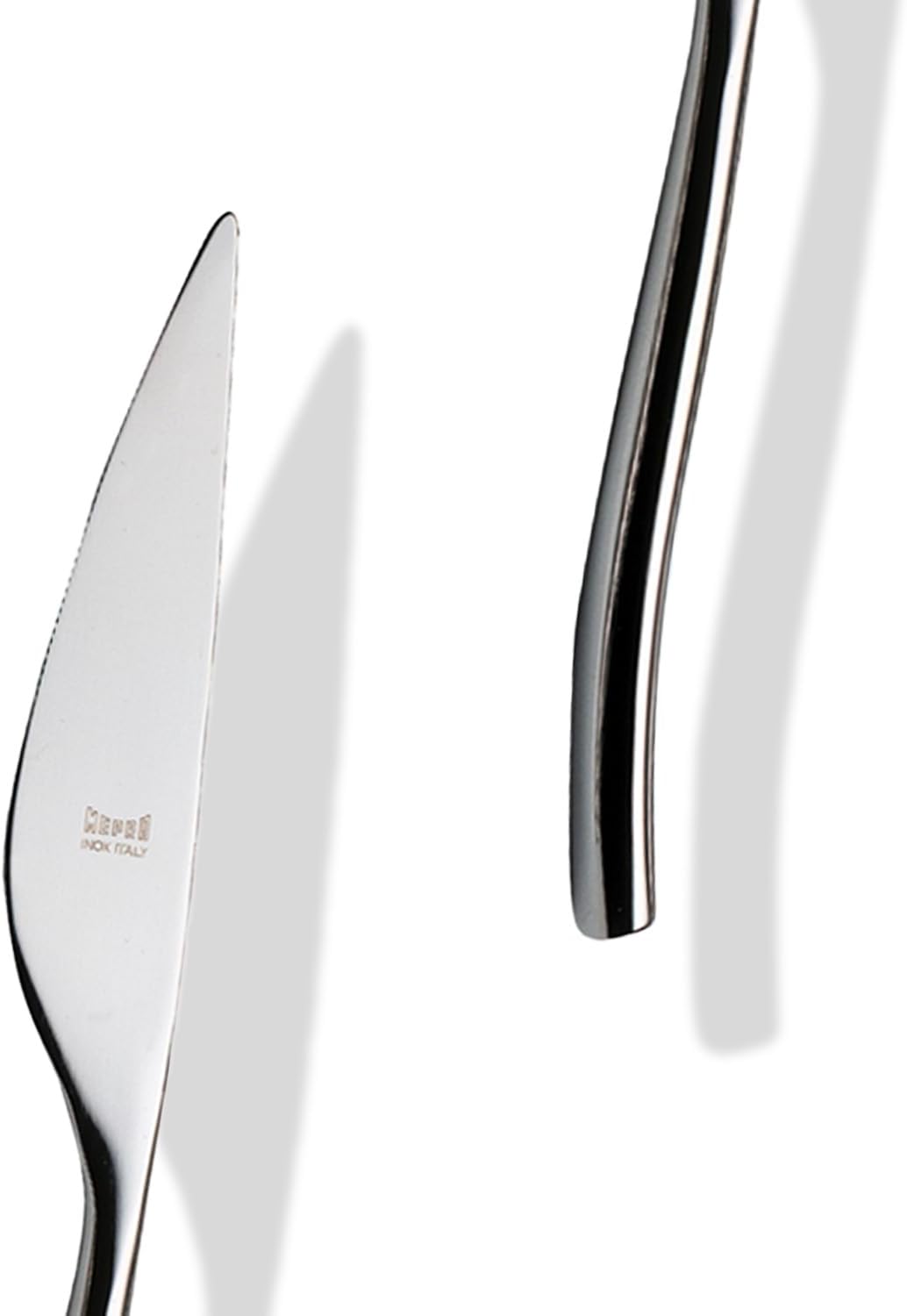
Flatware — the knives, forks, and spoons you set on a table — sounds simple until you start looking seriously. Every piece carries decisions about metal composition, surface finish, weight distribution, and design heritage that add up to something you’ll either love for decades or quietly regret. If you’ve started researching Italian flatware and landed on Mepra, you’ve already found one of Lombardy’s most respected production houses: a manufacturer based in Rodengo-Saiano, near Brescia, that has been making professional and residential cutlery since 1901. Stiria is one of its flagship patterns — satin-finished, architecturally minimalist, and frequently recommended in the design press. This article unpacks exactly what you’re buying if you go that direction: the pattern’s origins, the alloy behind the finish, the tradeoffs against comparable lines, and a clear decision framework for whether Stiria fits your specific situation.
| EDITOR'S PICK[MEPRA CUTLERY SET 24 PCS STIRIA](https://www.amazon.com/dp/B00G94BD66?tag=greenflower20-20)… | Mid-tier[Hudson Essentials Hammered 18/1](https://www.amazon.com/dp/B087WXQT7Z?tag=greenflower20-20)… | Budget pick[Artaste Rain II Forged 18/10 St](https://www.amazon.com/dp/B0CKC1Q4CF?tag=greenflower20-20)… | |
|---|---|---|---|
| Piece Count | 24 | 8 | 7 |
| Material | — | 18/10 Stainless | 18/10 Stainless |
| Pattern | Stiria | Hammered | Rain II |
| Finish | Silver Metallic | — | Forged |
| Type | Cutlery Set | Serving Utensil Set | Hostess Flatware Set |
| Dishwasher Safe | — | ✓ | — |
| Price | $225.00 | $59.95 | $39.97 |
| See on Amazon → | See on Amazon → | See on Amazon → |
Where Stiria Comes From: Design Lineage and Pattern Context
Mepra’s identity sits at the intersection of Italian industrial design and professional foodservice discipline. Unlike Florentine silversmiths who work from centuries-old atelier traditions — think Buccellati or the Valenza workshops producing sterling and silver-plated brass — Mepra operates as a scaled manufacturer whose clientele has always included Michelin-starred restaurants and hotel groups alongside residential buyers. That dual-channel heritage matters when you’re evaluating Stiria, because the pattern was conceived with both audiences in mind.
Stiria belongs to what Mepra internally categorizes as its stile contemporaneo group — patterns defined by clean geometric tapers, low ornamental relief, and finishes engineered for longevity under commercial dishwasher cycles. The name itself is the Italian rendering of Styria, the Alpine region that straddles northern Italy and Austria, and the reference is deliberate: the design draws on a restrained, mountain-inflected aesthetic that feels more Central European modernism than the baroque curves of traditional Italian silver. The silhouette is long and slender with a subtle upward pitch at the handle terminus — enough movement to give the piece visual life without demanding attention from the table setting around it.
The pattern debuted in the early 2010s as part of Mepra’s professional-line expansion, according to the company’s 2025 product catalog, and transitioned into broader residential distribution as consumer appetite for hospitality-grade flatware grew. That timing is relevant to registry buyers: Stiria is an active pattern, not a limited edition, which means replacement pieces and open-stock additions are genuinely available — a practical consideration the Apartment Therapy guide on registry-building specifically flags as a first-tier filter when evaluating any flatware commitment.
Alloy and Finish: What 18/10 Actually Means Here
Let’s get specific about the metal, because “stainless steel” is not a single material — and the difference between grades matters more than most registry guides acknowledge.
Stiria is specified in 18/10 stainless steel, which means the alloy contains 18% chromium and 10% nickel. The chromium creates the passive oxide layer that resists corrosion; the nickel percentage governs both surface luster and resistance to pitting under acidic foods and high-alkalinity dishwasher detergents. The 925-1000.com alloy reference database confirms that 18/10 is the upper tier of cutlery-grade stainless — the same specification used by Sambonet’s top residential lines and Oneida’s professional series — sitting clearly above the 18/0 and 13/0 grades common in budget flatware, where reduced nickel content produces a noticeably duller finish and faster surface degradation.
Mepra’s Stiria ships in a satin finish — a controlled linear brushing that diffuses light rather than mirroring it. Satin finishes are operationally smarter than high-mirror polish in daily-use contexts: they show fingerprints less, resist micro-scratch visibility better, and maintain their appearance through commercial dishwasher cycles without the visual “wear” that polished pieces can develop. Reviewers across aggregated design press coverage, including Elle Decor’s 2025 flatware roundup, consistently note that Mepra’s satin execution is unusually even, without the directional inconsistencies that cheaper brushing operations produce.
One tradeoff worth naming directly: satin is permanent in the sense that it’s the base finish, but it’s not maintenance-free. Owners in long-run reviews report that aggressive detergents — particularly those with chlorine bleach components — will degrade the brushed surface uniformity over time. Mepra’s published care specifications recommend chlorine-free detergents and drying cycles below 75°C. If your kitchen workflow involves high-heat commercial dishwashers without temperature control, build that into the decision.
By the Numbers: Stiria at a Glance
| Specification | Stiria Detail |
|---|---|
| Alloy grade | 18/10 stainless steel |
| Finish | Satin (brushed linear) |
| Typical 5-piece place setting retail (2026) | €85–€110 / $90–$120 USD |
| 12-cover service set (hospitality spec) | €1,100–€1,400 |
| Pattern status | Active (open stock available) |
Stiria vs. the Nearest Competitors: Where It Wins and Where It Doesn’t
This is the comparison a practitioner-level buyer actually needs. Three patterns compete most directly with Stiria in the design-forward satin-finish stainless segment: Sambonet’s Bamboo line, Mepra’s own Epoque, and Alessi’s Dry by Jasper Morrison.
Stiria vs. Sambonet Bamboo: Sambonet is also 18/10 Italian-made stainless, and Bamboo shares the elongated minimalist silhouette. The weight distribution differs: owners and hospitality buyers consistently describe Stiria as slightly heavier in the handle, which reads as more authoritative at the table. Bamboo’s finish is a shade warmer in tone — almost champagne-adjacent — versus Stiria’s cooler, neutral satin. Food & Wine’s 2025 flatware investment guide positions Sambonet as the stronger value at entry-level price points; Stiria pulls ahead in professional-volume procurement, where Mepra’s hospitality infrastructure (stocking programs, breakage replacement contracts) provides operational advantages Sambonet’s residential-focused distribution doesn’t match.
Stiria vs. Mepra Epoque: Both patterns share Mepra’s manufacturing standards, but Epoque introduces a slight concave indent along the handle spine that adds tactile interest at the cost of some of Stiria’s boardroom-clean geometry. If you’re building a registry that needs to work across formal dinners and everyday use, Stiria’s neutrality is the safer long-term bet. Epoque reads more statement-forward — better for a host who wants the flatware to be a conversation piece, less ideal for tablescapes where the china pattern or glassware is the visual anchor.
Stiria vs. Alessi Dry: This is the sharpest tradeoff. Alessi’s Dry is arguably the most influential minimalist Italian flatware pattern of the last two decades — Jasper Morrison’s design work is canonized in design press coverage at Architectural Digest level, and the pattern commands premium positioning despite being manufactured in 18/10 at a similar price tier. What Dry has that Stiria doesn’t is design provenance and collectibility. What Stiria has that Dry doesn’t is Mepra’s hospitality-volume infrastructure and the durability reputation that comes from restaurant-context stress. For collectors, Dry wins on heritage. For working tables — either residential with real daily use or commercial — Stiria’s edge is operational.
Registry Math: The Decision Frame
Here’s where the practitioner calculus gets concrete. You’re not just buying a pattern; you’re making a commitment that compounds through replacement purchases, gifted additions, and the eventual decision whether to pass these pieces on.
If you’re building a residential registry for 12 covers: A full 12-cover Stiria service in the standard five-piece configuration (dinner fork, salad fork, dinner knife, soup spoon, teaspoon) runs approximately $1,080–$1,440 at 2026 retail. Add serving pieces — two to four items is typical — and you’re at $1,200–$1,600 total. That’s below the threshold of the Ricci or Greggio silver-plated programs (which typically start at $300+ per place setting), but it’s not impulse money. The active-pattern status means you can register for eight covers now and add four covers as gifts arrive — Replacements Ltd’s Mepra archive confirms Stiria pieces have been consistently available as open stock since the pattern’s introduction, which removes the scarcity anxiety that complicates discontinued-pattern collecting.
If you’re specifying for a hospitality program: A 12-cover service at hospitality contract pricing (typically 15–25% below retail through Mepra’s professional distribution network, per the company’s published trade program documentation) lands at roughly $900–$1,200 for a standard five-piece cover. Factor in a 20–30% breakage/replacement buffer across a three-year procurement cycle and you’re budgeting $1,150–$1,550 per 12 covers — well within the range that mid-tier boutique restaurant and private-club buyers treat as a credible program, and less than half the cost of silver-plated hospitality programs from specialist Florentine silversmiths where a comparable specification exceeds $4,000.
If you’re a collector watching pattern continuity: Stiria’s active status is a double-edged signal. On one hand, you’ll never scramble for replacement pieces the way a Buccellati or discontinued Christofle collector does. On the other hand, an active 18/10 stainless pattern from a commercial manufacturer does not appreciate — it’s a use acquisition, not an investment acquisition. If your interest tilts toward provenance and value accrual, Stiria is the wrong category entirely; redirect toward pre-owned sterling or silver-plated patterns through Replacements Ltd’s specialist inventory or specialist dealers with authenticated Broggi or Buccellati holdings.
The Clear If-Then Decision Rule
After running the comparisons and the math, the decision frame resolves cleanly:
If your priority is an active, design-forward Italian pattern with hospitality-grade durability in 18/10 stainless, a neutral satin aesthetic that serves any tablescape, and an operational infrastructure that supports long-term registry or procurement additions — then Stiria is one of the two or three strongest choices in its price tier, and the tradeoffs against Sambonet Bamboo or Alessi Dry are genuinely marginal rather than decisive.
If you need design provenance to anchor a collector identity, silver-plate depth for formal entertaining theater, or a pattern you expect to appreciate in secondary-market value — then Stiria’s category is wrong for you, and the budget is better directed toward a smaller set of silver-plated Mepra Dolce Vita pieces or an entry into the Sambonet’s sterling-collaboration archive.
If you’re a hospitality buyer evaluating Stiria against generic contract stainless at a lower price point — then the 18/10 specification, Mepra’s breakage replacement infrastructure, and the visual credibility the pattern carries in design-aware dining contexts almost certainly justify the premium over a commodity contract line. The math is tighter at low table-turn restaurants; it favors Stiria decisively at clubs and boutique hotels where the flatware is part of the experiential brand.
Stiria isn’t the most romantic choice in Italian flatware — that distinction still belongs to the ateliers working in Valenza and Florence with materials that carry centuries of craft memory. But as a precision-engineered, design-serious, professionally deployable pattern, it makes the case for Italian industrial silversmithing on its own terms. That’s a different kind of excellence, and for the right table, it’s exactly enough.