May 13, 2026 • James Barrett • 9 min reading time • Prices verified June 24, 2026
Oneida's Italian-Named Patterns — Michelangelo, Moda, Tuscany — Ranked for the Design-Forward Host
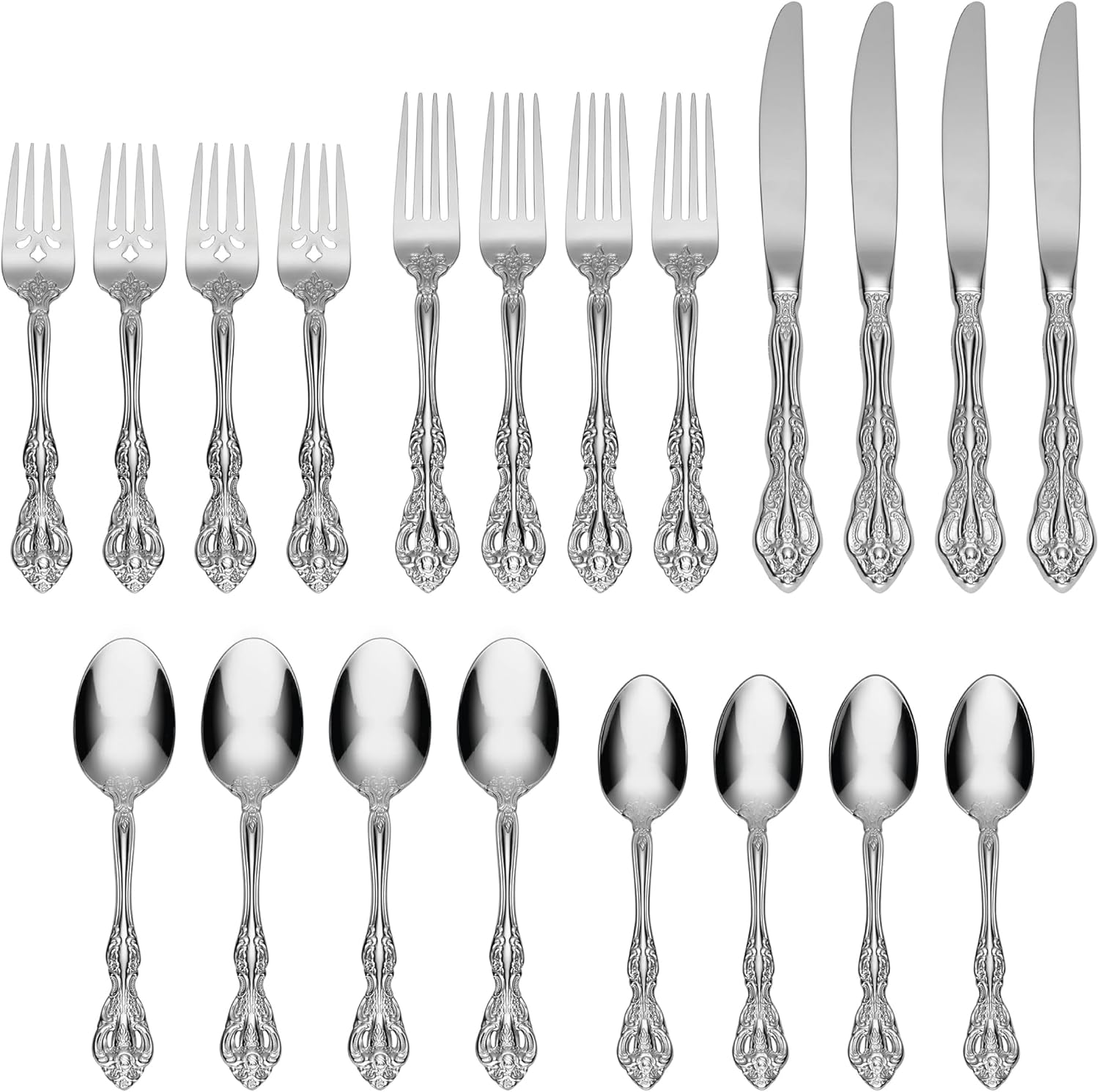
Flatware is the part of the table you actually hold — the object your guests pick up within the first ten seconds of sitting down. If you’ve started researching silverware and keep running into the name Oneida, you’re looking at one of America’s largest and longest-running flatware manufacturers, a company founded in upstate New York in the 1880s that has, over the decades, named a surprising number of its patterns after Italian cities, artists, and lifestyle words. Michelangelo. Moda. Tuscany. The names conjure Florentine silversmiths and sun-drenched piazzas. The reality is more complicated — and more interesting than either the marketing or the skeptics suggest.
This guide is for the host who already knows enough to be suspicious of borrowed Italian branding, but wants an honest, comparative answer: Which of these patterns actually earns a place at a considered table, and which is best left to the banquet hall? We’ll rank all three on the criteria that matter to this audience — construction grade, visual character, collectibility, and how each sits alongside genuinely Italian silverware if you ever decide to mix or upgrade.
| EDITOR'S PICK[Oneida Silverware Set For 12](https://www.amazon.com/dp/B003NCVX8U?tag=greenflower20-20) | Mid-tier[Oneida Silverware Set For 4](https://www.amazon.com/dp/B00004WA8I?tag=greenflower20-20) | Budget pick[Oneida Silverware Set](https://www.amazon.com/dp/B00008QUJR?tag=greenflower20-20) | |
|---|---|---|---|
| Piece Count | 65 | 20 | 5 |
| Service For | 12 | 4 | 1 |
| Weight Class | — | Heavyweight | — |
| Includes Serving | ✓ | ✗ | ✗ |
| Price | $118.21 | $89.32 | $22.52 |
| See on Amazon → | See on Amazon → | See on Amazon → |
What “Italian-Named” Actually Signals — and What It Doesn’t
The naming strategy isn’t unique to Oneida. Dozens of American and European mass-market brands have long attached Italian and French appellations to mid-range patterns, borrowing cultural cachet without the underlying craft geography. Understanding where your flatware is designed, manufactured, and finished matters more than the name on the box.
Oneida’s current production is largely manufactured in offshore facilities, with some professional-line pieces still meeting tighter commercial-grade specifications for the U.S. foodservice market. The 18/10 stainless steel grade cited across all three patterns under review refers to the alloy’s chromium-to-nickel ratio (18% chromium, 10% nickel) — a standard the industry uses as a proxy for corrosion resistance and a mirror-bright finish that holds up in commercial dishwashers. For comparison, 925-1000.com’s alloy reference notes that 18/10 is the same grade used by Sambonet and Mepra in their entry-to-mid professional lines, so the raw material floor is respectable.
What 18/10 doesn’t tell you: handle thickness, balance point, the depth of any decorative stamping, or whether the pattern was designed with ergonomic intentionality or simply licensed from a style archive. That’s where the three patterns diverge sharply.
The Patterns, Ranked
1. Michelangelo — The One Worth Taking Seriously
Michelangelo is, by a meaningful margin, the strongest design in Oneida’s Italian-named portfolio, and it’s the one most likely to hold its own at a table that also features genuine Italian pieces.
What the pattern is: A baroque-influenced handle with a pronounced central rib, scrolled shoulder detailing, and a slightly weighted feel that owners across aggregated reviews consistently describe as “substantial” — a word that rarely appears in reviews of Oneida’s lighter commercial lines. The spoon bowls are well-proportioned; the dinner knife has a pistol-grip handle geometry that sits comfortably at a European place setting angle.
Construction note: Published spec sheets list Michelangelo in Oneida’s heavier commercial gauge, intended for hotel and club use — the same tier that Food & Wine’s 2025 flatware roundup identified as the category where Oneida “punches above its price bracket in durability.”
The honest tradeoff: The baroque vocabulary is specific. If your table leans toward the clean Milanese minimalism of Sambonet’s Gio Ponti revival pieces or Mepra’s Aria line, Michelangelo will read as a period mismatch. But if your aesthetic runs toward the Roman palazzo — heavy linen, candlelight, a centerpiece that suggests an old cardinal’s dining room — it is genuinely coherent. Architectural Digest’s December 2024 table-setting feature specifically cited maximalist European revival as one of two dominant directions in 2025 entertaining, which gives Michelangelo a current tailwind it hasn’t always had.
Collectibility: Replacements Ltd carries Michelangelo in their active inventory with reasonable pattern completeness — serving pieces, specialized place knives, and the harder-to-find iced beverage spoon. That depth of secondary-market coverage matters if you’re building a set incrementally or replacing attrition pieces years from now. It’s not Buccellati, but it’s not a dead end either.
Verdict: If you are choosing one Oneida Italian-named pattern to anchor a formal entertaining set or to round out a mixed-manufacturer table at the $60–$120 per-five-piece-place-setting price point, Michelangelo is the defensible choice.
2. Moda — The Right Answer for a Specific Brief
Moda is the pattern most Italian in spirit, even if the design language is more international-contemporary than specifically Florentine or Milanese.
What the pattern is: A clean, tapered handle with minimal surface decoration, a slight concave channel running the full handle length, and a satin-finish option alongside the standard mirror polish. The knife handle is slim — reviewers note this is a deliberate break from the heavier European handles — which reads as modern but can feel insubstantial to hands accustomed to sterling or silver-plated brass.
Construction note: Moda appears in Oneida’s standard commercial-gauge listings rather than the heavier hotel tier. The Spruce Eats’ updated February 2026 buying guide places lines at this gauge in the “excellent for everyday to casual formal” category, noting they perform well through repeated dishwasher cycles but may show micro-abrasion on satin finishes faster than mirror-polished alternatives.
Where it works: The satin-finish Moda is a genuinely compelling choice for a design-forward host whose table is built around matte ceramics, raw linen, and natural-edge wood boards — the aesthetic that Italian design publications have been calling cucina povera elevated for the last several years. In that context, it reads as intentional restraint rather than budget compromise.
The honest tradeoff: Moda is harder to mix with vintage or heritage Italian pieces precisely because it occupies a stylistic no-man’s-land — too minimal to complement baroque Broggi or Christofle colonial patterns, not quite rigorous enough to stand next to a Mepra Fantasia or a Sambonet professional line. It’s best when it owns the table rather than sharing it.
Collectibility: Secondary-market depth is thinner than Michelangelo. If long-term pattern availability matters to your decision, factor in that a registry or collection built around Moda carries more replacement risk a decade out.
Verdict: Best for: the host building a new, coherent casual-formal table from scratch who prioritizes aesthetic consistency over heritage narrative. Not recommended as a long-term collection anchor.
3. Tuscany — Honest Assessment of a Tourist-Name Pattern
Tuscany is the hardest of the three to recommend without significant qualification, which is worth stating plainly.
What the pattern is: A mid-weight handle with a simple oval cross-section, minimal decorative stamping limited to a band near the shoulder, and a mirror finish that is, per published specifications, in Oneida’s standard rather than premium gauge. The name is the most aggressively Italian of the three; the design is the least.
The core problem: Tuscany’s design vocabulary is generic in a way that Michelangelo and Moda aren’t. Aggregated owner reviews describe it consistently as “clean” and “inoffensive” — damning with faint praise in a category where the best pieces generate genuine admiration. There is no point of view in the handle that connects to any particular silversmithing tradition or contemporary design movement. It exists in the same middle register as dozens of interchangeable mid-market patterns from American and Asian manufacturers.
Where it legitimately earns its place: Rental companies and event caterers report exactly this kind of neutral, legible pattern as preferable for mixed-guest events precisely because it doesn’t compete with the food or décor. If you are outfitting a property rental, a catering operation, or a lake house where the flatware will take hard use from guests who are not flatware enthusiasts, Tuscany’s durability-per-dollar math is acceptable.
Collectibility: Low. Secondary-market pattern depth is shallow, and there’s limited collector or replacement demand that would sustain a long-term set-building strategy.
Verdict: If X is “I need durable, presentable flatware for high-turnover or communal use and pattern integrity doesn’t matter,” then Tuscany is fine. If X is “I’m building a table I’m proud of,” then look at Michelangelo, Moda, or redirect budget toward entry Sambonet or Mepra, where $80–$150 buys something with genuine Italian provenance.
By the Numbers
| Pattern | Gauge Tier | Secondary Market Depth | Aesthetic Fit: Heritage Italian | Aesthetic Fit: Contemporary Minimal |
|---|---|---|---|---|
| Michelangelo | Heavy commercial | Strong (Replacements Ltd active) | High | Low |
| Moda | Standard commercial | Moderate | Low | High |
| Tuscany | Standard commercial | Thin | None | Low |
How These Patterns Fit a Longer Collection Journey
If you’re reading this site, you’re probably not making a single purchase and stopping. The more useful framing is: what role does an Oneida Italian-named pattern play in a table that will evolve?
Michelangelo has a plausible long-term role as a secondary service set — the pieces that come out when the primary sterling or silver-plate is in the chest and you need to seat eighteen. Its baroque register actually harmonizes with Broggi’s more ornate historical patterns and with Christofle’s Italian-collaboration pieces from the 1980s and 1990s, which The Spruce Eats’ flatware guide notes have been gaining secondary-market traction among younger collectors.
Moda, if you’re committed to the contemporary minimal direction, is better understood as a bridge piece while you determine whether Mepra’s Aria or Sambonet’s thinner-gauge professional lines are your real destination. At current market pricing, the cost differential between Moda and entry Mepra stainless is narrow enough that the upgrade is worth running the math on before committing.
Tuscany doesn’t fit the collection-building model. Buy it for utility; don’t build an identity around it.
The Decision Rule
If your table aesthetic is baroque-formal and your budget ceiling is $120 per five-piece place setting: Michelangelo is the right Oneida answer, with reasonable long-term replacement security and a design that holds its own in mixed company.
If your table is contemporary-minimal and you’re building from scratch: Moda earns a look, but spend thirty minutes comparing it against Mepra entry stainless before buying — the gap between “Italian-named American flatware” and “actual Italian flatware” closes faster at that price tier than most buyers realize.
If you’re considering Tuscany for a design-forward table: Redirect. The name is doing work the design isn’t.
The goal of every flatware decision on a considered table is the same: that the pieces in your guests’ hands feel like they belong there — not like they were named for somewhere better.