May 16, 2026 • James Barrett • 8 min reading time • Prices verified June 24, 2026
Wallace Grande Baroque and Gorham Strasbourg: A Collector's Guide to American Sterling with Italian Roots
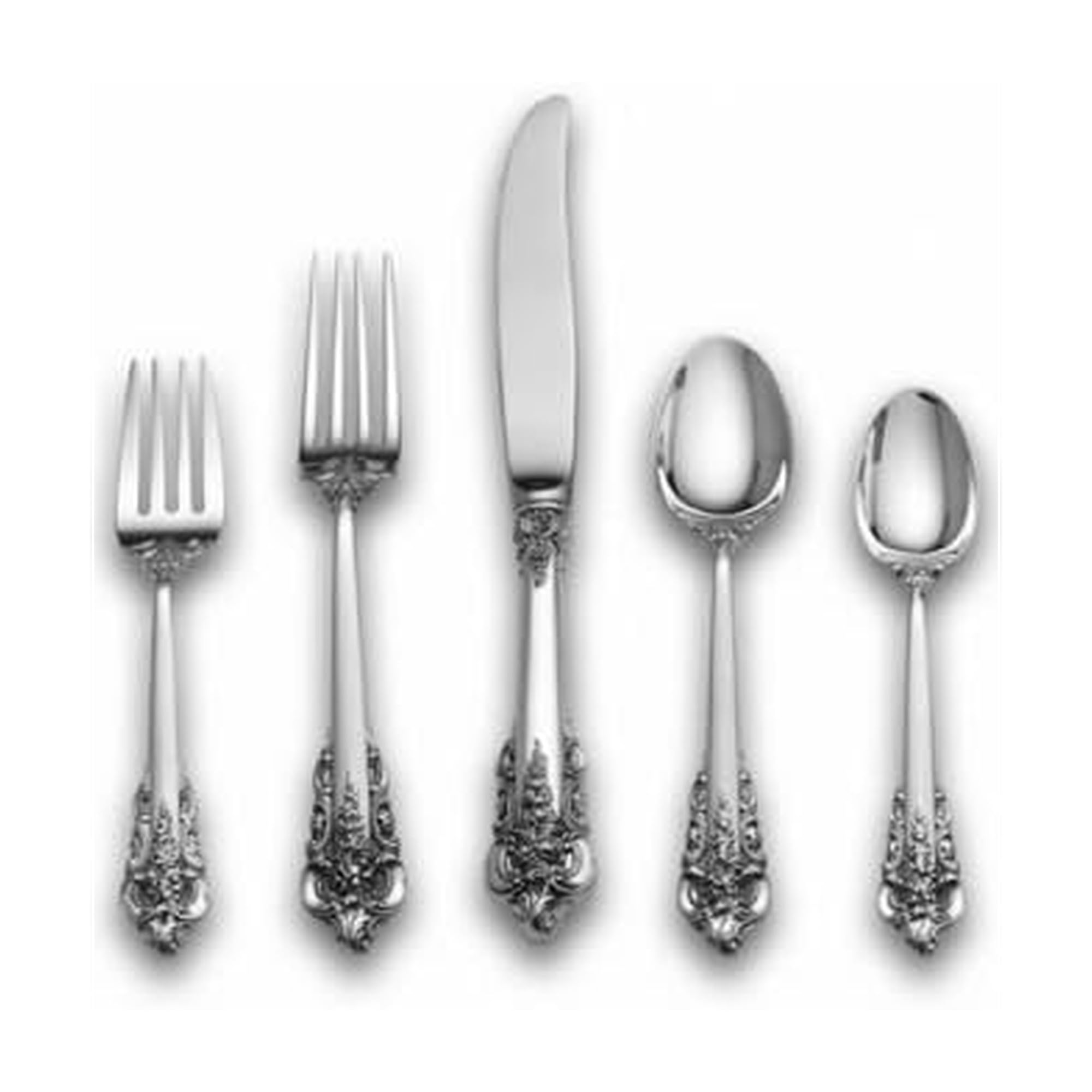
If you’ve ever browsed an antique market and picked up a heavy, ornately carved silver fork — one that felt almost absurdly luxurious in your hand — there’s a good chance it was either Wallace Grande Baroque or Gorham Strasbourg. Both are patterns in sterling silver flatware (that means pieces made from an alloy that is at least 92.5% pure silver, always stamped “925” or “Sterling” in the United States). They were designed and produced by two of America’s great silver houses, but their visual language is unmistakably rooted in the Italian and European baroque tradition: deep relief carving, scrolling acanthus leaves, and the kind of sculptural weight that makes a dinner table feel like an event. This guide is for the collector or registrant who has already decided they want one of these patterns — and needs a clear-eyed comparison to choose the right one, pay the right price, and avoid the pitfalls that trip up even experienced buyers.
The Design Lineage: Why “Italian Roots” Isn’t Just Marketing
Neither Wallace nor Gorham was an Italian company, but both patterns were drawing directly from a well that Italian baroque silversmiths had been filling for three hundred years.
Wallace Grande Baroque was introduced in 1941 by Wallace Silversmiths of Wallingford, Connecticut. The pattern takes its visual grammar from 17th-century Roman and Neapolitan ornamental silverwork — specifically the heavy, almost theatrical scrollwork associated with workshops operating under papal and noble patronage in the 1670s–1720s. The border treatment, with its C-scroll cartouches and shell motifs at the terminal, closely mirrors the decorative vocabulary you see in Valenzano and Florentine ecclesiastical silver of the same period. As the 925-1000.com American Sterling Hallmarks Reference notes, Grande Baroque became Wallace’s best-selling pattern within a decade of introduction and has never been discontinued — a remarkable commercial continuity driven almost entirely by word-of-mouth among collectors and brides.
Gorham Strasbourg is the older pattern, introduced in 1897 by Gorham Manufacturing of Providence, Rhode Island. Where Grande Baroque went theatrical, Strasbourg went architectural. Its cartouches are tighter, the acanthus scrolls more controlled, and the overall silhouette is slimmer — closer to the restrained Italian Renaissance silver of Florentine goldsmiths than to full baroque excess. The name “Strasbourg” is a nod to the Alsatian silversmithing tradition, but the actual design pulls more from 16th-century Italian sources: the pointed terminal and the fine cross-hatching at the shank are hallmarks of Florentine work that Gorham’s 19th-century design team clearly studied. Architectural Digest’s 2024 piece on sterling at the table specifically cited Strasbourg as an example of “the European atelier vocabulary that American manufacturers absorbed and made their own.”
Understanding this lineage matters practically, not just aesthetically. It tells you why both patterns sit comfortably beside Italian sterling pieces from Buccellati or Broggi — and why, if you’re building a mixed-heritage collection or a registry that anchors American silver alongside Italian acquisitions, either of these patterns transitions naturally rather than clashing.
By the Numbers: Market Snapshot, May 2026
| Metric | Wallace Grande Baroque | Gorham Strasbourg |
|---|---|---|
| Typical 5-pc place setting (secondary market) | $280–$420 | $320–$480 |
| Serving pieces (per piece, secondary market) | $95–$340 | $110–$380 |
| New old stock / mint condition premium | +25–40% | +30–50% |
| Silver spot sensitivity (LBMA fix, May 2026 ~$34/troy oz) | High — weight per setting approx. 5–6 troy oz | High — weight per setting approx. 4.5–5.5 troy oz |
| Active listings on Replacements Ltd (May 2026) | ~1,400 individual pieces | ~900 individual pieces |
Pricing compiled from Replacements Ltd active listings and dealer aggregates, May 2026. Spot sensitivity calculated on melt-weight basis only — decorative and pattern premiums are additive.
The Collector’s Tradeoff: Availability vs. Scarcity Premium
This is the core decision frame for anyone with a purchase pending right now.
Grande Baroque has depth; Strasbourg has scarcity. With roughly 1,400 individual pieces listed on Replacements Ltd alone (per their active inventory as of May 2026), Grande Baroque is about as close to a liquid market as discontinued American sterling gets. You can complete a twelve-cover service — including all five standard pieces plus salad forks, butter spreaders, and serving sets — without hunting for years. The tradeoff is that deep supply compresses appreciation potential. At current silver spot near $34 per troy oz (LBMA fix, May 2026), a mint-condition Grande Baroque five-piece setting is priced at roughly 2.5–3× its melt value, which is a normal decorative premium. But it’s unlikely to spike dramatically unless spot silver itself moves sharply upward.
Strasbourg’s shallower secondary-market pool (~900 pieces at Replacements, fewer at specialist dealers) means a different calculus. Collectors report — consistently, across auction aggregates and dealer feedback — that complete Strasbourg serving sets in excellent condition now command 35–50% above equivalent Grande Baroque pieces of the same function. If you find a matching pair of Strasbourg serving spoons in original condition, the right move is to buy them immediately. They will not be cheaper next month.
There’s a third variable that intermediate collectors sometimes underweight: pattern completeness and the orphan-piece problem. Grande Baroque has such robust secondary-market coverage that you’re unlikely to end up with a service where, say, the fish forks are a decade-old acquisition in slightly different polish than everything else. With Strasbourg, you will almost certainly encounter this. Plan for it. Budget a professional restoration polish from a silversmith (not a home dip — The Spruce Eats’ 2025 guide on sterling care explicitly warns against chemical dips for heavily patterned flatware, noting they pool in relief carving and strip patina unevenly) as a line item in your total acquisition cost.
Authentication: What to Check Before You Buy
Both patterns have been in continuous or semi-continuous production long enough that you’ll encounter pieces from multiple manufacturing eras on the secondary market. Era matters for hand-feel, weight, and finish quality.
For Wallace Grande Baroque: Look for the Wallace “W” hallmark with the word “Sterling” struck separately on the shank (reverse of the handle). Pre-1956 pieces often show a slightly heavier gauge — owners and longtime dealers consistently report the tactile difference between pre- and post-1960 production as meaningful, with earlier pieces feeling more substantial in the hand. The 925-1000.com hallmarks reference is the definitive free resource for dating Wallace strikes by hallmark variant. Post-1986 pieces produced under the Syratech acquisition era (Syratech purchased Wallace in 1986) are genuine sterling but show slightly thinner gauge profiles on hollow-handle knives — check the knife handles specifically.
For Gorham Strasbourg: Gorham’s hallmarking is more complex. Early pieces (1897–1930) carry the Gorham lion-anchor-G mark plus “Sterling.” Post-1930 pieces transition through several die variants documented in the 925-1000.com Gorham entry. The critical authentication point for Strasbourg is the cartouche definition on the terminal: authentic pieces show crisp, three-dimensional relief with distinct shadow depth. Worn or electroplated reproductions (yes, they exist — Strasbourg’s fame made it a target for silver-plate knockoffs in the mid-20th century) show flattened scrollwork and a uniform reflective surface without the micro-texture of hand-chased or die-struck sterling.
When buying from any dealer other than a specialist like Replacements Ltd with documented provenance, the minimum due diligence is: weigh the piece (a standard Strasbourg dinner fork should run 2.0–2.4 troy oz), check the hallmark under magnification, and test with a neodymium magnet — sterling is not magnetic; silver-plated steel will hold a magnet clearly.
If X, Then Y: The Decision Rules
You’ve read the comparison. Here’s how to close the loop on a current decision.
If you’re building a registry and want a pattern you can complete over a lifetime without stress: Choose Wallace Grande Baroque. The secondary market depth means you, your wedding guests, and your adult children can add to the service across decades without hunting. The Italian baroque visual language holds beautifully beside Mepra stainless for everyday use and Buccellati sterling for formal occasions.
If you’re a collector buying for appreciation and willing to do the hunting: Gorham Strasbourg’s shallower pool and higher condition premiums make it the stronger speculative hold, particularly for serving pieces. A complete Strasbourg service in original condition — soup ladle, gravy boat, cold-meat fork, all matched — is genuinely difficult to assemble today and will be harder in five years.
If silver spot continues its 2025–2026 upward drift above $34/troy oz: Both patterns appreciate in melt-floor value, but the collector premium on Strasbourg insulates it better. Grande Baroque’s higher available supply means more motivated sellers if spot spikes and liquidation pressure increases.
If you’re sourcing for a boutique hospitality program and need a signature identity without bespoke fabrication costs: Grande Baroque’s availability makes it serviceable for twelve-cover programs in the $3,500–$5,000 range (five-piece settings × twelve covers plus serving). Strasbourg at that volume would require a dedicated search campaign and likely a 15–20% premium over equivalent Grande Baroque pricing.
If pattern completeness is non-negotiable for your use case: Grande Baroque, without hesitation. Strasbourg is a collector’s pattern now; Grande Baroque is still a working-table pattern with collector upside.
The honest synthesis is that these are not competing patterns so much as patterns for different collector temperaments. Grande Baroque rewards patience, table use, and the pleasure of a service that gets more beautiful as it gets more lived-in. Strasbourg rewards the hunter — the collector who checks Replacements Ltd and specialist auction houses on a Tuesday morning and is ready to move when a matched set of serving pieces surfaces. Both carry genuine Italian baroque design heritage, both are genuine sterling, and both will outlast any table they’re set on. The question is simply which relationship with the chase you’re signing up for.